Everyday Safety
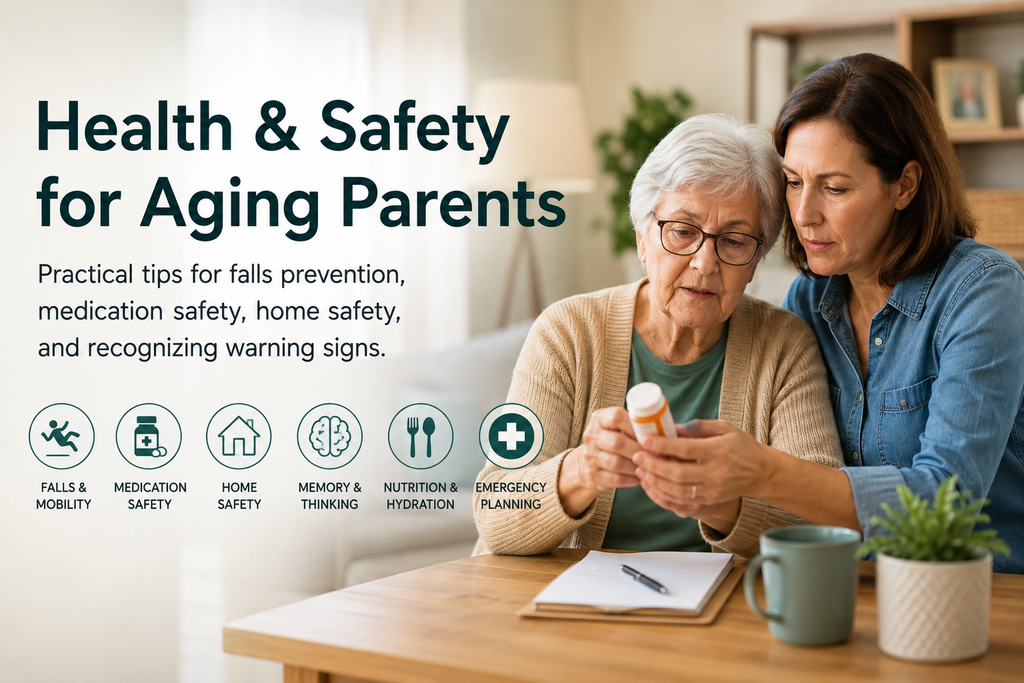
Health & Safety for Aging Parents: Falls, Medications, Home Safety & Warning Signs
When an aging parent begins having health or safety problems, families often struggle to determine what is normal aging, what needs attention, and what should be handled first.
This guide helps families evaluate common concerns involving falls, medications, mobility, memory changes, driving, nutrition, home hazards, emergency preparedness, daily functioning, and the ability to live safely and independently.
The goal is not to diagnose your parent. It is to help you recognize meaningful changes, ask better questions, improve everyday safety, and know when professional evaluation may be appropriate.
Quick Answer: How Can I Help Keep My Aging Parent Safe?
Start by reviewing six areas: home safety, falls and mobility, medications, memory and thinking, daily functioning, and emergency preparedness.
Look for changes rather than assuming every difficulty is simply part of getting older. Repeated falls, medication mistakes, sudden confusion, unexplained weakness, unsafe driving, difficulty eating, inability to manage basic daily activities, or a rapidly changing condition may deserve professional evaluation.
If there is no immediate emergency, focus first on the problem creating the greatest risk and then work through the remaining areas one at a time.
The Aging Parent Safety Snapshot
When something feels different with a parent, it can be difficult to know where to begin. Instead of evaluating everything at once, use these six areas as a practical first review.
1. Home
Are there loose rugs, dark hallways, unsafe stairs, clutter, bathroom hazards, difficult entrances, or other conditions that increase injury risk?
2. Mobility
Has your parent fallen, stumbled, become weaker, started holding onto furniture, or had increasing difficulty walking or getting up?
3. Medications
Are prescriptions being taken correctly? Are doses missed, duplicated, confused, or mixed with over-the-counter medicines or supplements without appropriate review?
4. Mind
Are there changes in memory, judgment, orientation, behavior, decision-making, or the ability to complete familiar tasks?
5. Daily Life
Can your parent still manage meals, hygiene, dressing, shopping, transportation, bills, appointments, and household responsibilities safely?
6. Emergency Readiness
Could your parent get help during a fall, fire, power outage, severe weather event, hospitalization, or other emergency?
A problem in one area does not automatically mean your parent can no longer live independently. The important question is whether risks can be reduced enough for your parent to remain safe with the support available.
Not Sure Where to Begin? Start Here →Falls and Mobility: One of the Most Important Safety Areas
Falls can have serious consequences for older adults, but many fall risks can be identified and reduced. The National Institute on Aging notes that fall risk increases with age and recommends approaches such as reviewing medications, improving home safety, addressing vision and hearing, and working on strength and balance when appropriate.
Signs Fall Risk May Be Increasing
- A recent fall or near fall
- Holding onto walls or furniture while walking
- New dizziness or lightheadedness
- Difficulty standing from a chair
- Weakness or reduced endurance
- Difficulty using stairs
- Changes in vision or hearing
- Foot pain or unsafe footwear
- Fear of falling that limits normal activity
Practical Fall-Prevention Steps
- Keep walking paths clear
- Improve lighting, especially near stairs
- Secure or remove loose rugs
- Install appropriate handrails
- Consider grab bars where needed
- Use nonslip surfaces in wet areas
- Discuss dizziness or medication side effects with a healthcare professional
- Ask whether strength, balance, vision, hearing, or mobility should be evaluated
After a fall, ask why it happened. A fall may involve more than the floor or a loose rug. Medication effects, weakness, balance problems, vision changes, dehydration, illness, footwear, blood-pressure changes, and environmental hazards may all contribute.
Home Safety for Aging Parents
A home that worked well for decades may become harder to navigate when eyesight, balance, strength, mobility, hearing, or memory changes.
A useful home-safety review should look at the house from the perspective of the person using it today—not the person who lived there ten years ago.
| Area | What to Look For | Possible Safety Improvements |
|---|---|---|
| Entrances | Steps, uneven surfaces, poor lighting, difficult locks or doors | Better lighting, secure rails, easier access and appropriate accessibility modifications |
| Stairs | Loose rails, objects on steps, poor visibility, slippery surfaces | Secure handrails, clear stairs, improve lighting and repair unsafe flooring |
| Bathroom | Slippery tubs, difficult transfers, low toilet, lack of support | Appropriate grab bars, nonslip surfaces, improved lighting and adaptive equipment when needed |
| Bedroom | Difficult bed transfers, dark route to bathroom, clutter | Clear pathways, accessible lighting and safer furniture placement |
| Kitchen | Burn hazards, hard-to-reach items, spoiled food, forgotten appliances | Reorganize frequently used items, improve lighting and address appliance-safety concerns |
| Living Areas | Loose rugs, cords, clutter, unstable furniture | Clear walking paths, secure flooring and remove trip hazards |
| Emergency Access | No phone nearby, inability to summon help, locked entrances | Accessible phone, emergency contacts, alert system when appropriate and a family access plan |
The National Institute on Aging specifically recommends good lighting, secure carpeting, clear pathways, grab bars near toilets and bathing areas, and nonslip surfaces where floors may become wet. :contentReference[oaicite:2]{index=2}
Medication Safety for Older Adults
Medication management can become increasingly complicated when an older parent takes several prescriptions, over-the-counter medicines, vitamins, or supplements.
The FDA notes that aging-related changes in the body and the use of multiple medicines can increase the potential for side effects and drug interactions. :contentReference[oaicite:3]{index=3}
Medication Safety Questions Families Can Ask
- Does your parent know what each medication is for?
- Can they reliably take the correct medication at the correct time?
- Are doses being skipped or accidentally repeated?
- Are expired or discontinued medicines still mixed with current prescriptions?
- Do all healthcare providers know what prescriptions, over-the-counter medicines, vitamins, and supplements your parent takes?
- Has your parent experienced new dizziness, sleepiness, confusion, weakness, or other possible side effects?
- Has a pharmacist or healthcare professional reviewed the full medication list recently?
Do not independently stop, change, combine, split, or adjust a prescribed medication based solely on website information. Medication changes should be discussed with an appropriate healthcare professional or pharmacist.
Memory Changes, Confusion and Cognitive Safety
Occasional forgetfulness and significant cognitive change are not the same thing.
Families should pay attention when memory or thinking problems begin interfering with safety, judgment, finances, medications, driving, cooking, appointments, navigation, communication, or basic daily routines.
Changes Worth Discussing With a Healthcare Professional
- Getting lost in familiar places
- Repeatedly forgetting important appointments or conversations
- Taking medications incorrectly
- Uncharacteristically poor financial decisions
- Leaving appliances on or creating new household hazards
- Increasing difficulty completing familiar tasks
- Major changes in judgment or behavior
- Wandering or leaving home unexpectedly
- Difficulty recognizing familiar people or surroundings
- Confusion that is becoming more frequent or severe
Sudden confusion is different from gradual memory decline. A rapid change in thinking or awareness can sometimes occur with an acute medical problem and should not automatically be assumed to be dementia or normal aging.
If cognitive changes are beginning to affect your parent’s ability to remain safely alone, it may also be time to explore whether additional supervision or a different care arrangement is needed.
Compare Care Options for Aging Parents →Can Your Parent Still Manage Daily Activities Safely?
Health and safety are not measured only by diagnoses. How a parent functions in everyday life is often equally important.
Families and care professionals commonly look at both basic personal-care tasks and more complex activities required for independent living.
Basic Daily Activities
Watch for increasing difficulty with:
- Bathing
- Dressing
- Eating
- Using the bathroom
- Walking and transferring
- Personal hygiene
Independent-Living Activities
Also watch for problems with:
- Preparing meals
- Shopping
- Managing medications
- Paying bills
- Transportation
- Housekeeping
- Scheduling appointments
- Using phones or other essential technology
A change in one task does not automatically determine where someone should live. The pattern, severity, cause, available support, and consequences of the difficulty all matter.
How Do You Know When an Aging Parent’s Driving May Be Unsafe?
Age alone does not determine whether someone can drive safely. The more useful question is whether changes in vision, cognition, reaction time, mobility, medication effects, or driving behavior are increasing risk.
Driving Warning Signs Families May Notice
- New dents, scrapes, or unexplained vehicle damage
- Getting lost on familiar routes
- Confusing the gas and brake pedals
- Difficulty staying in a lane
- Missing traffic signs or signals
- Increasing near misses
- Becoming overwhelmed in ordinary traffic
- Driving unusually slowly or unpredictably
- Recent vision, cognitive, or medical changes that may affect driving
- Family members, friends, or professionals expressing repeated concern
If driving becomes unsafe, the conversation is often easier when the family also discusses transportation alternatives. The goal is not simply to remove keys; it is to preserve mobility and independence as safely as possible.
Nutrition, Hydration and Food Safety
Changes in eating and drinking habits can provide important clues about an older parent’s health and ability to manage independently.
Possible Warning Signs
- Unexplained weight loss
- Very little food in the home
- Spoiled or expired food being eaten
- Difficulty shopping for groceries
- Difficulty cooking safely
- Problems chewing or swallowing
- Frequently skipping meals
- Signs that drinking enough fluids has become difficult
These problems can have many causes. Dental problems, medication effects, mobility limitations, depression, cognitive change, illness, finances, transportation, and difficulty preparing food may all play a role.
Persistent or unexplained changes in weight, eating, swallowing, or hydration should be discussed with an appropriate healthcare professional.
Emergency Planning for an Aging Parent
Families often think about emergency planning only after a fall, hospitalization, storm, power outage, or other crisis.
A basic plan can make it easier for family members and emergency professionals to respond quickly.
Information to Keep Accessible
- Emergency contacts
- Current medication list
- Allergies
- Healthcare providers
- Insurance information
- Important medical information
- Preferred hospital when applicable
- Relevant legal or healthcare documents
- Information about pets
- Home access information for trusted family members when appropriate
Ask: Could My Parent Get Help After a Fall?
If your parent lives alone, consider what would happen if they fell and could not reach a phone.
Depending on the person’s circumstances, options may include carrying a mobile phone, scheduled family check-ins, wearable emergency-alert devices, or other appropriate monitoring and communication systems.
Signs an Aging Parent May No Longer Be Managing Safely Alone
Families often search for one definitive sign that a parent should no longer live alone. In reality, the decision usually comes from a pattern of concerns rather than a single event.
| What You Notice | What It May Tell You | Possible Next Step |
|---|---|---|
| Repeated falls | Mobility, medication, balance, vision or environmental risks may need review | Discuss fall risk with an appropriate healthcare professional and evaluate the home |
| Medication mistakes | The current medication system may no longer be reliable | Review medications and supervision needs with healthcare professionals |
| Increasing confusion | Cognitive or medical evaluation may be needed | Arrange appropriate professional assessment |
| Poor hygiene or unchanged clothes | Personal-care tasks may be becoming difficult | Explore the reason and level of assistance required |
| Spoiled food or weight loss | Shopping, cooking, eating or health may be affected | Evaluate nutrition, medical and support needs |
| Unpaid bills or unusual spending | Financial management or cognition may be changing | Review finances carefully and consider appropriate professional guidance |
| Unsafe driving | Vision, cognition, mobility or reaction time may be affecting driving | Discuss driving safety and transportation alternatives |
| Caregiver can no longer keep up | The amount of care required may have exceeded available support | Explore additional in-home help or other care options |
If several concerns are occurring together, your family may need to reassess both the amount of support being provided and whether the current living arrangement remains appropriate.
Explore Home Care, Assisted Living, Memory Care & Other Options →What Should You Do When You Notice a Health or Safety Problem?
Identify the Specific Change
Instead of saying, “Mom isn’t doing well,” write down what actually happened. For example: two falls this month, three missed doses of medication, getting lost twice, or spoiled food repeatedly left in the refrigerator.
Determine Whether It Is Urgent
A sudden major change or immediate danger should be handled differently from a gradual concern that can be discussed at an upcoming appointment.
Talk With Your Parent
Whenever possible, involve your parent in the conversation. Focus on the specific issue and the goal of preserving safety and independence rather than taking control away unnecessarily.
Bring Specific Information to Healthcare Professionals
Dates, examples, medication lists, falls, symptoms, functional changes and observations are more useful than vague descriptions.
Match the Support to the Problem
A transportation problem does not automatically require assisted living. A medication problem may need a medication-management system. A fall risk may require healthcare evaluation and home changes. Choose support based on the actual need.
Reassess
Aging-parent safety is not a one-time decision. Revisit the plan after a fall, hospitalization, new diagnosis, medication change, major functional change, or other significant event.
Health & Safety Does Not Mean Taking Away Independence
Families sometimes wait too long to discuss safety because they fear that raising concerns automatically means taking away a parent’s independence.
That does not have to be the goal.
A better question is:
“What support would make it safer for my parent to keep doing as much as possible independently?”
Sometimes the solution is relatively small: better lighting, transportation, meal support, medication organization, a mobility aid recommended by a professional, or help with one particular task.
At other times, health, cognitive, or functional needs may become significant enough that additional caregiving or a different living arrangement should be considered.
How Health & Safety Connects With Other Aging Parent Decisions
Health and safety concerns often lead directly to other decisions. Use these sections when the next problem extends beyond this page.
Does Your Parent Need More Care?
Compare aging in place, home care, assisted living, memory care, skilled nursing and other options.
Explore Care Options →Are You Just Beginning?
Use our starting framework to identify which part of your parent’s situation needs attention first.
Start Here →Are Care Costs Becoming a Concern?
Learn about Medicare, Medicaid, benefits, care expenses and financial-assistance topics.
Money & Benefits →Are You Managing Most of the Care?
Explore family caregiving, communication, organization, caregiver responsibilities and support.
Family Caregiving →Frequently Asked Questions About Aging Parent Health & Safety
What are the biggest safety concerns for an aging parent living alone?
Common concerns include falls, medication mistakes, mobility problems, memory or judgment changes, unsafe driving, difficulty preparing food, inability to manage daily activities, home hazards, and not being able to summon help during an emergency.
How do I know if my elderly parent is safe living alone?
Look beyond whether your parent prefers living alone. Consider whether they can safely manage medications, meals, hygiene, mobility, household tasks, finances, transportation, emergencies and other essential daily activities. Repeated problems in several areas may indicate that more support is needed.
What should I do if my aging parent keeps falling?
Repeated falls should not simply be dismissed as normal aging. Discuss them with an appropriate healthcare professional and review possible contributors such as medications, balance, strength, vision, hearing, footwear, dizziness and hazards in the home.
What should I do if my parent is taking medications incorrectly?
Medication mistakes deserve prompt attention because taking the wrong medicine or dose can be dangerous. Bring an accurate list of prescriptions, over-the-counter medicines, vitamins and supplements to a healthcare professional or pharmacist and discuss the safest medication-management approach.
Is forgetfulness a normal part of aging?
Minor memory changes can occur with age, but memory problems that interfere with everyday activities, safety, judgment, navigation, medication management or finances deserve closer evaluation. Sudden confusion should be treated differently from gradual memory change and may require prompt medical attention.
When is it no longer safe for an aging parent to live alone?
There is no single universal threshold. The decision depends on the severity and frequency of safety problems, cognitive and medical needs, daily functioning, whether reliable assistance is available, and whether identified risks can be reduced enough for the parent to remain safe.
How can I make my elderly parent’s home safer?
Start with clear walking paths, appropriate lighting, secure flooring, safe stairs and handrails, bathroom safety, accessible everyday items, and a reliable way to call for help. A professional home-safety assessment may be useful when mobility or fall risk is significant.
How often should I reassess my parent’s safety?
There is no single schedule that fits every family. Reassess whenever there is a significant change such as a fall, hospitalization, new medical condition, medication change, cognitive decline, mobility change, driving concern or increasing difficulty managing everyday activities.
Does needing help mean my parent needs assisted living?
No. Many older adults can remain at home with targeted support such as transportation, meal services, home modifications, family help, personal care or appropriate home health services. The right level of care depends on the type and intensity of help required.
Sources & Editorial Review
Because health and safety information can affect important family decisions, Aging Parent Tips uses authoritative sources when developing educational content and encourages readers to verify individualized health questions with qualified professionals.
Information for this guide was reviewed against current materials from the National Institute on Aging and the U.S. Food and Drug Administration.